Case Study of Madaket Payer Enrollment Relaunch
Madaket Health is a SaaS provider in the US healthcare space, specifically focused on making it easier for providers to
manage their relationships with the payers that they offer to their patients.
I was principal designer on Madaket's first product, which focused on EDI Enrollment. It now manages data for over 600,000
healthcare providers that handle their EDI enrollment with over 4,000 different US private insurance companies and has
performed over 5 million transactions.
For their second product, Madaket wanted to stand a beta product up quickly by reusing EDI code and capture some of the adjacent Payer Enrollment Market segment. This was done as a quick vertical slice that did not consider differences in the markets or their users. I was brought in to help rework the user experience and relaunch the product as a successful and useful offering for healthcare providers.
Situation
- Start with engineering proof-of-concept and refine the web application to suit the needs of new customers
- Communicate with customers to define pain points and rework the user experience
- Homogenize the experience of applications on our platform with consistency in design and interaction
Some initial concerns:
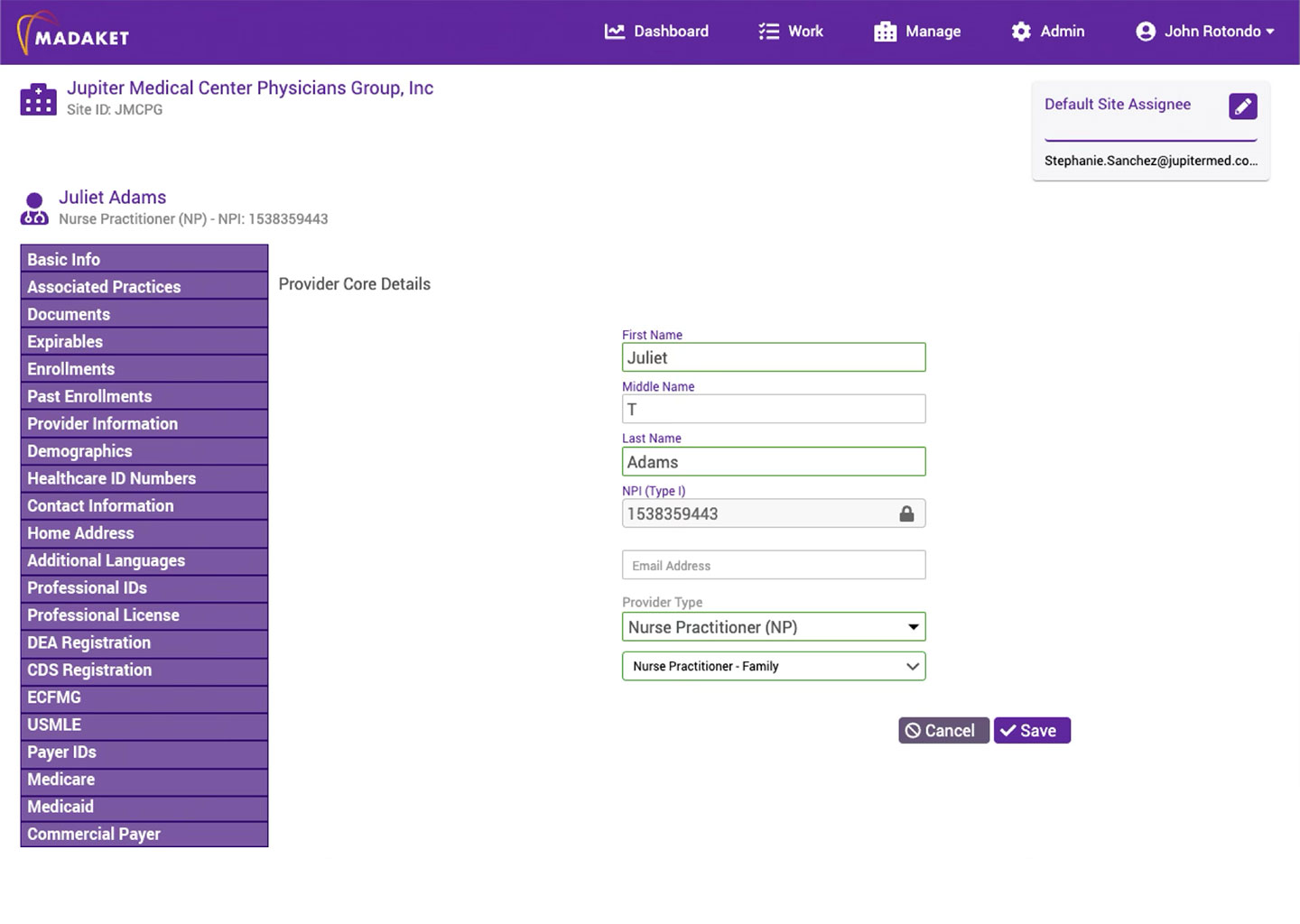
- Data is an unsorted laundry list
- Tons of scrolling required
- General polish level was extremely rushed (spelling mistakes, punctuation)
- Zero form validation
- Alignment issues, messy layout
Task
- Application must be more approachable and easier to use than competitive products
(like IntelliSoft, Symplr and Modio) - Relaunch to existing users and document the improvement in their experience, measure improvement in their product usage
- More product traction in sales demos
Action
The project began as a proof-of-concept with an engineering team. The team built functionality based around our understanding of EDI enrollment, and created a Payer Enrollment application using similar work flows. This fed into a few tasks that the team decided to focus on:
- Payer Enrollment users may not think the same, or face the same challenges as EDI enrollment users. Review and define actual user personas.
- Data models might vary greatly between EDI and Payer Enrollment. Review and update Information Architecture
- Task flows may differ greatly between EDI and Payer Enrollment. Review and update task flows
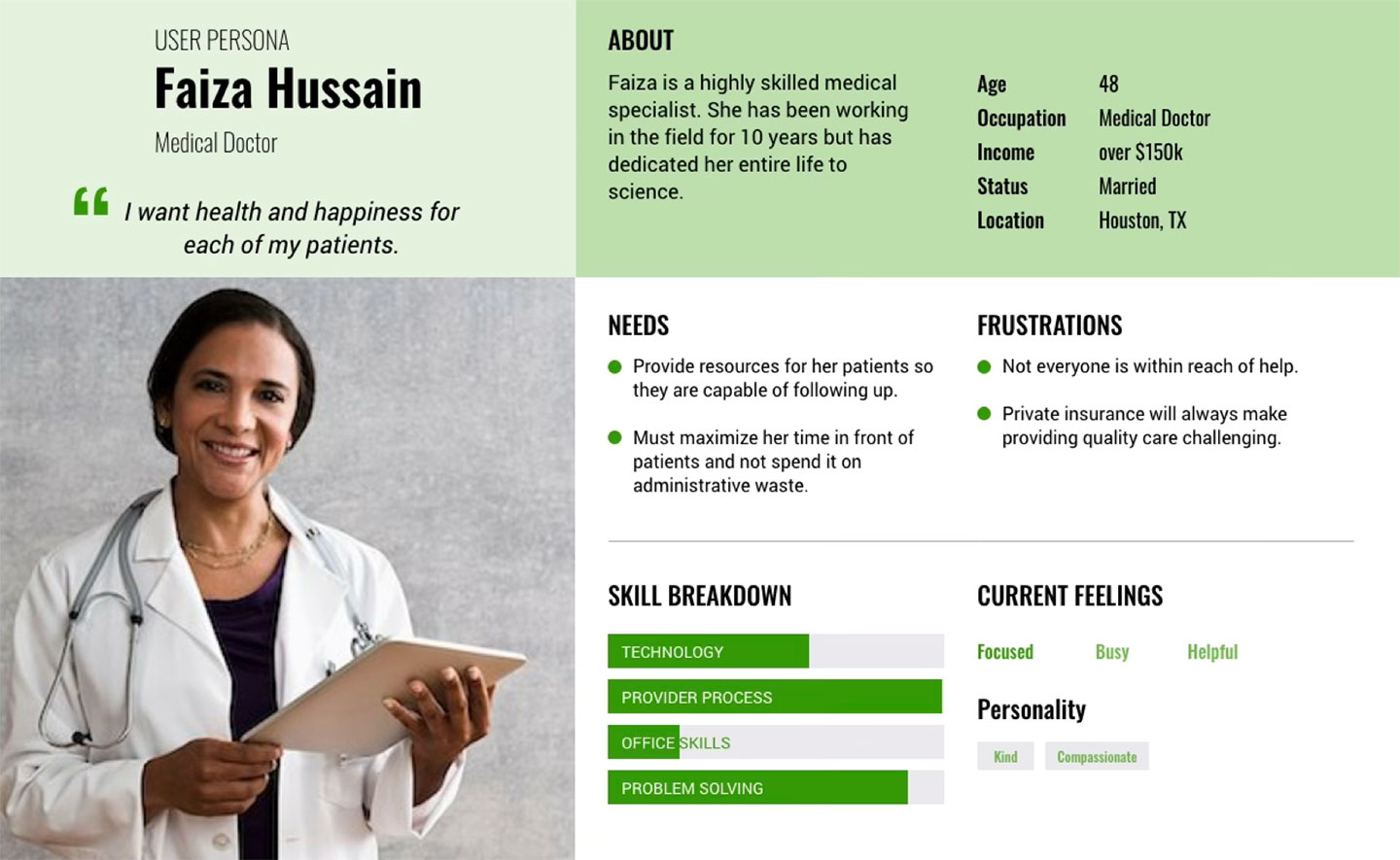
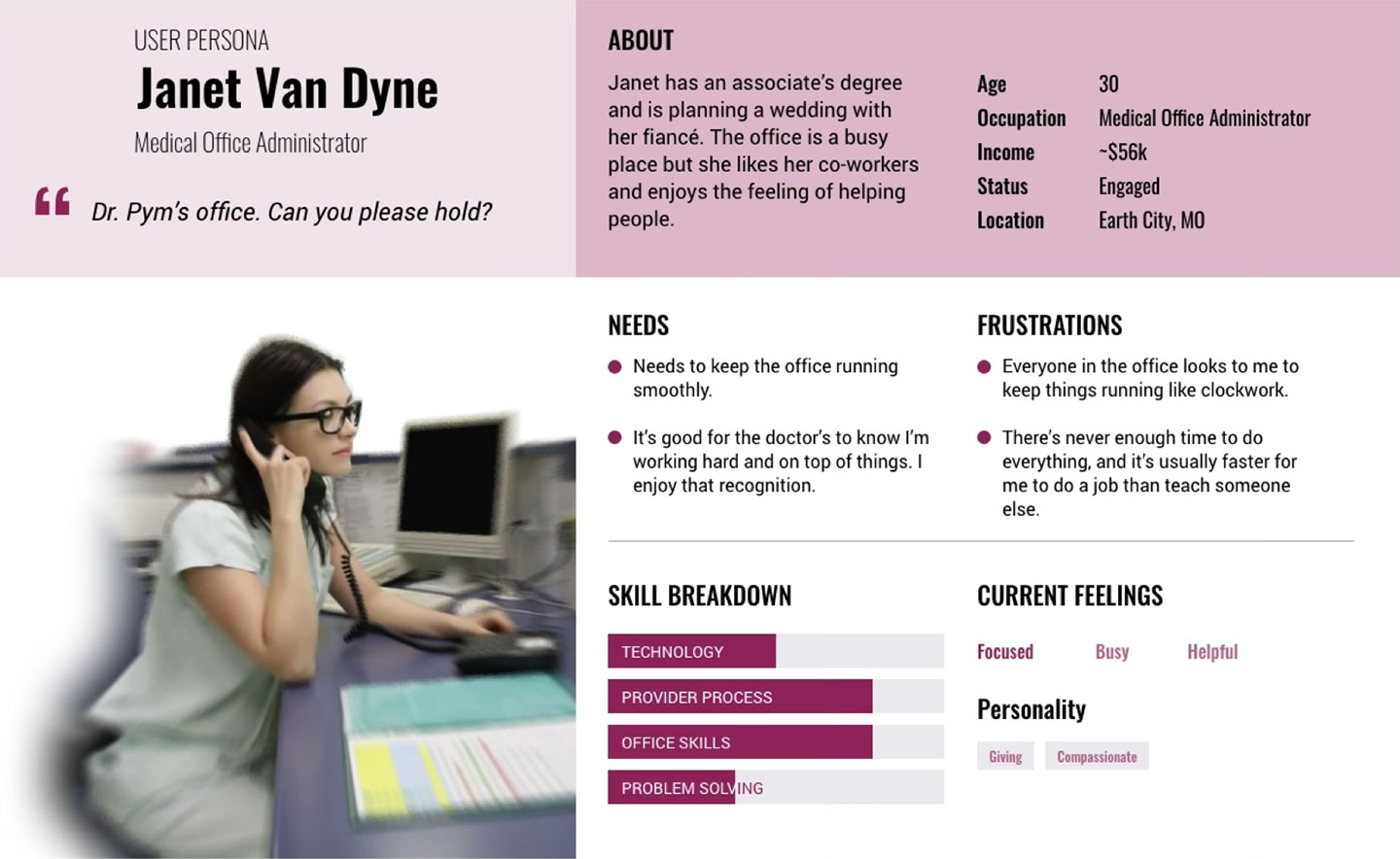
Personas: Who we thought would use the product
Our engineering team made the assumption that Payer Enrollment users would be similar users to our EDI enrollment users:
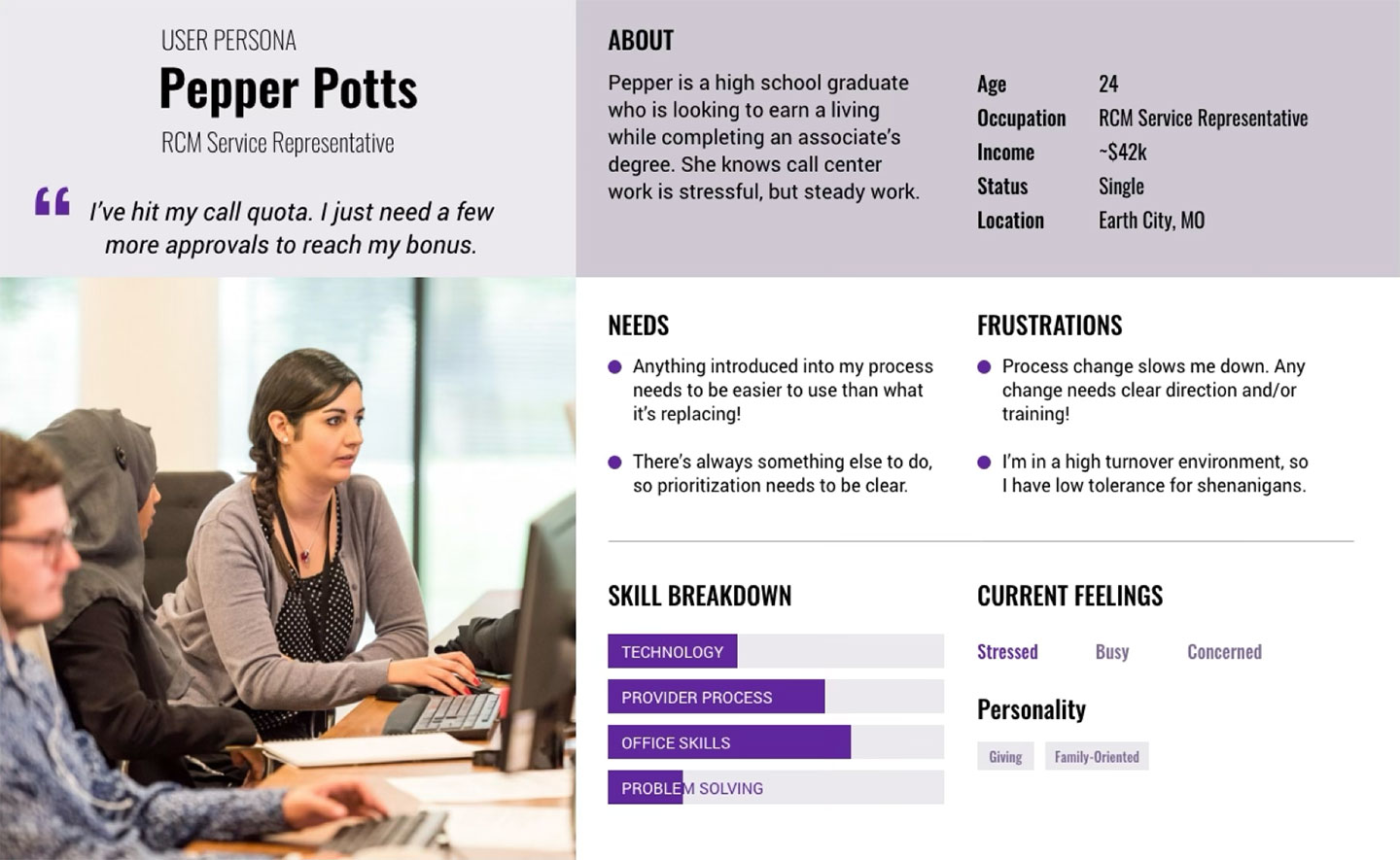
Personas: Who actually will use the product
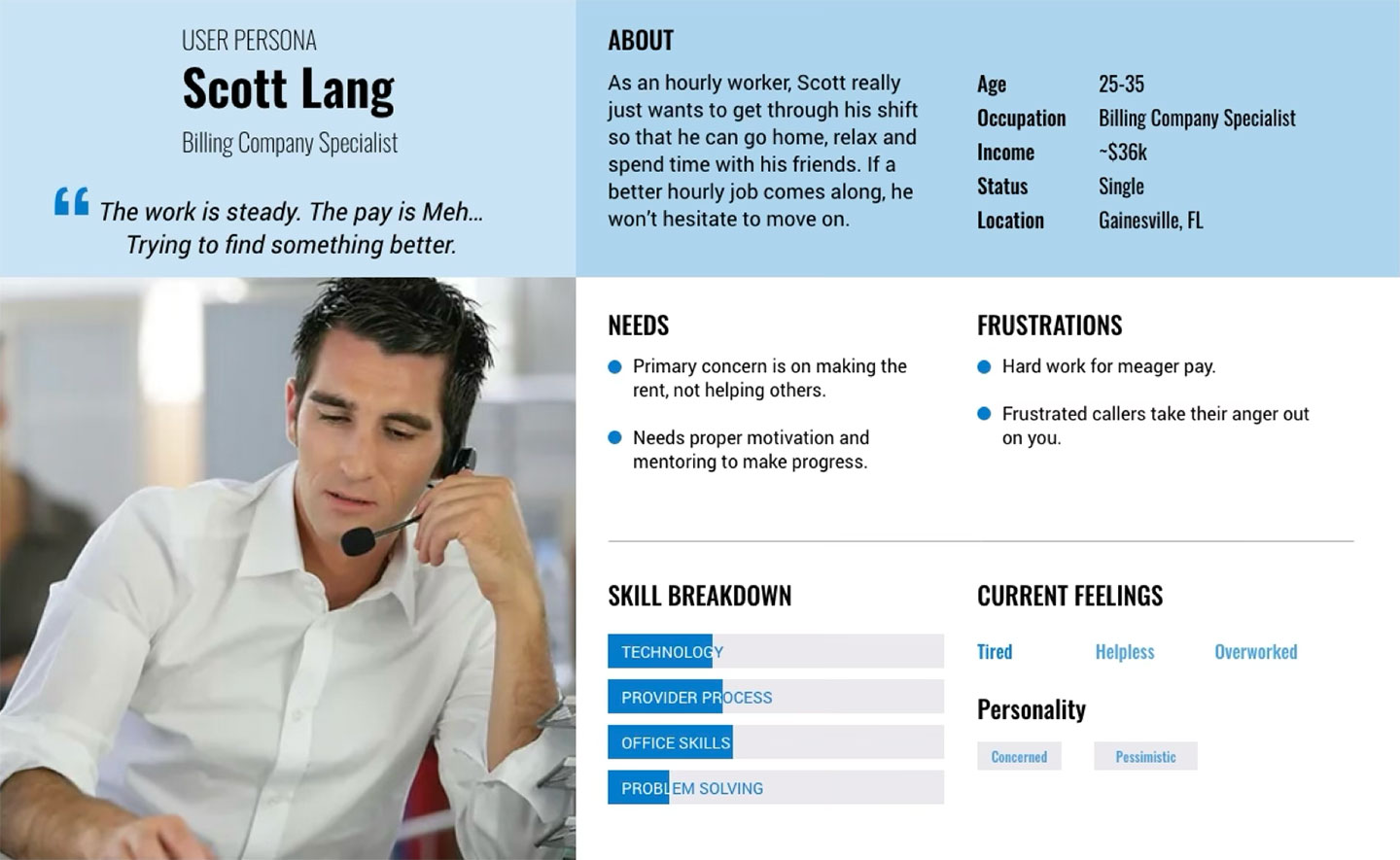
Persona Insight
- RCM vendors are not utilized as much as billing companies in the Payer Enrollment space, but our engineering team would not have known that without research and feedback interviews.
- Primary users are less motivated to learn new software
- Primary users are less skilled in technology
- Primary users work in high stress, high turnover environments
- Especially with billing representatives, they are difficult to communicate with as their employers want them to be solving problems, not talking on the phone with non-customers.
- Without direct commmunication with billing reps, the next best things was to join social media groups where these users visit to ask questions and provide support for each other. This provided an indirect communication method with a primary user type, and also gave us a history of related questions and answers to mine for insight.
Informatation Architecture
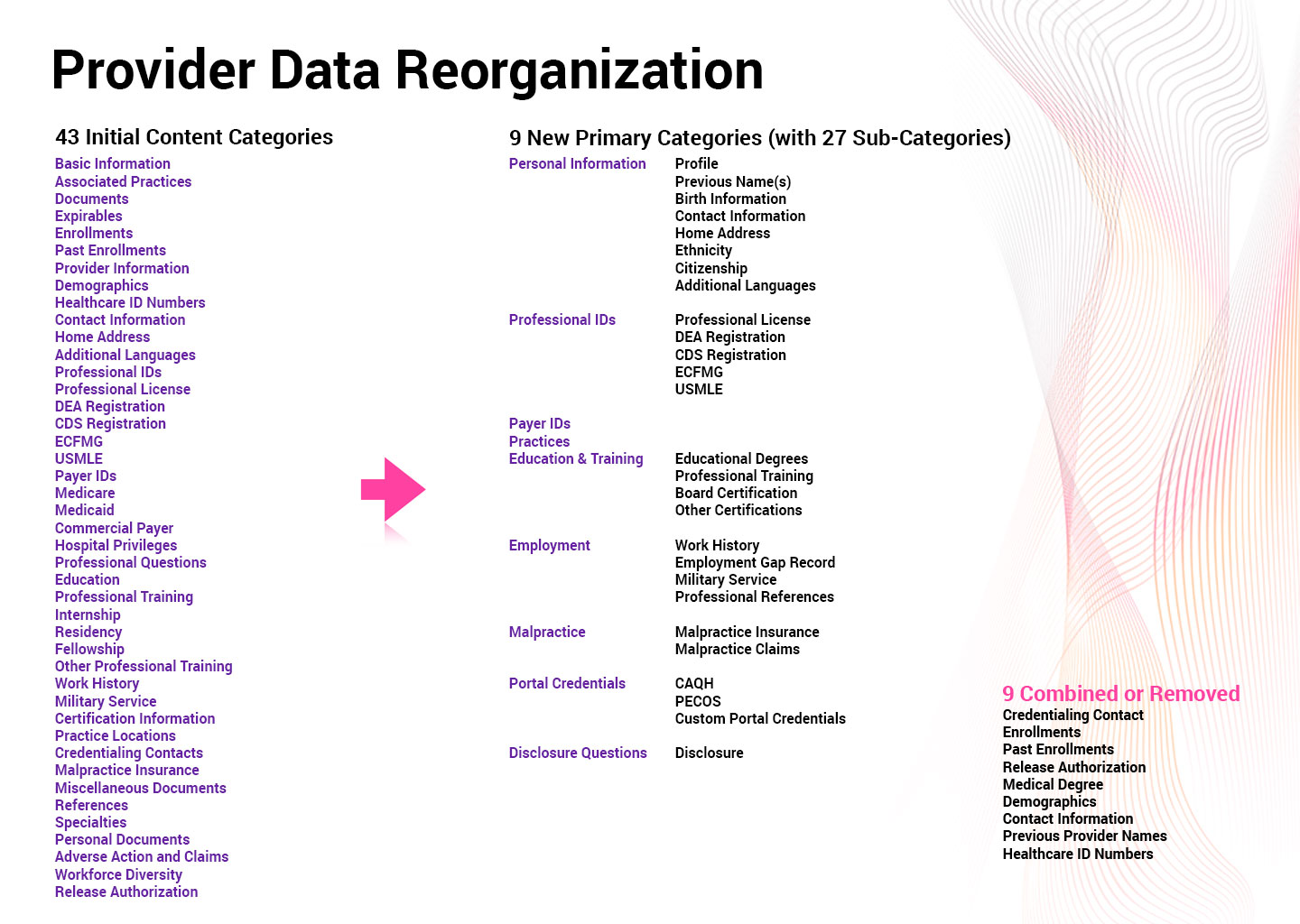
Referring back to the initial proof-of-concept, it is clear that data is fairly unorganized. There are 43 categories of data content on the provided entity alone. The initial team assumed that a similar approach to what was done in Madaket's EDI Enrollment product would work just as well for Payer Enrollment, not accounting for the fact that there is an exponentially higher volume of data required for payer enrollment, and it requires constant attestation every 90 days. Additionally, what little competitive research was done to see how other products organized this information, relied too heavily on Jakob's Law (users prefer what they are already familiar with), and not enough upon Miller's Law (the average person can hold only 5 to 9 items in their short-term memory at once) or Hick's Law (the relationship between the number of choices available and the time it takes to make a decision).
Outcome: After consulting with users of the current application and matching personas over social media, we were able to validate a consolidation of our data.
- 43 initial provider information blocks
- Reorganized into 8 Primary Categories with 27 Sub-Categories
- 9 content blocks either combined or removed completely
Revised information hierarchy deserves a refined profile editor
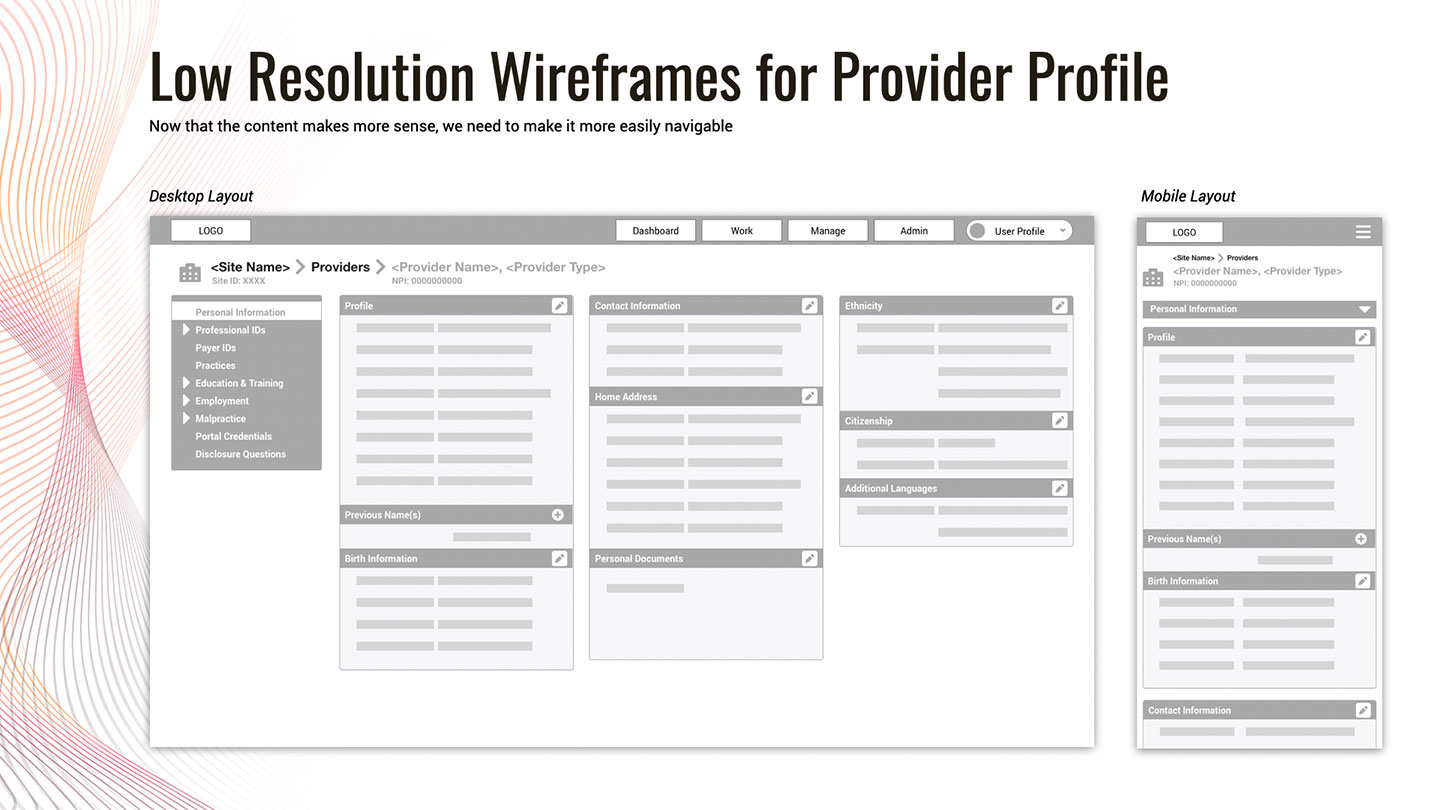
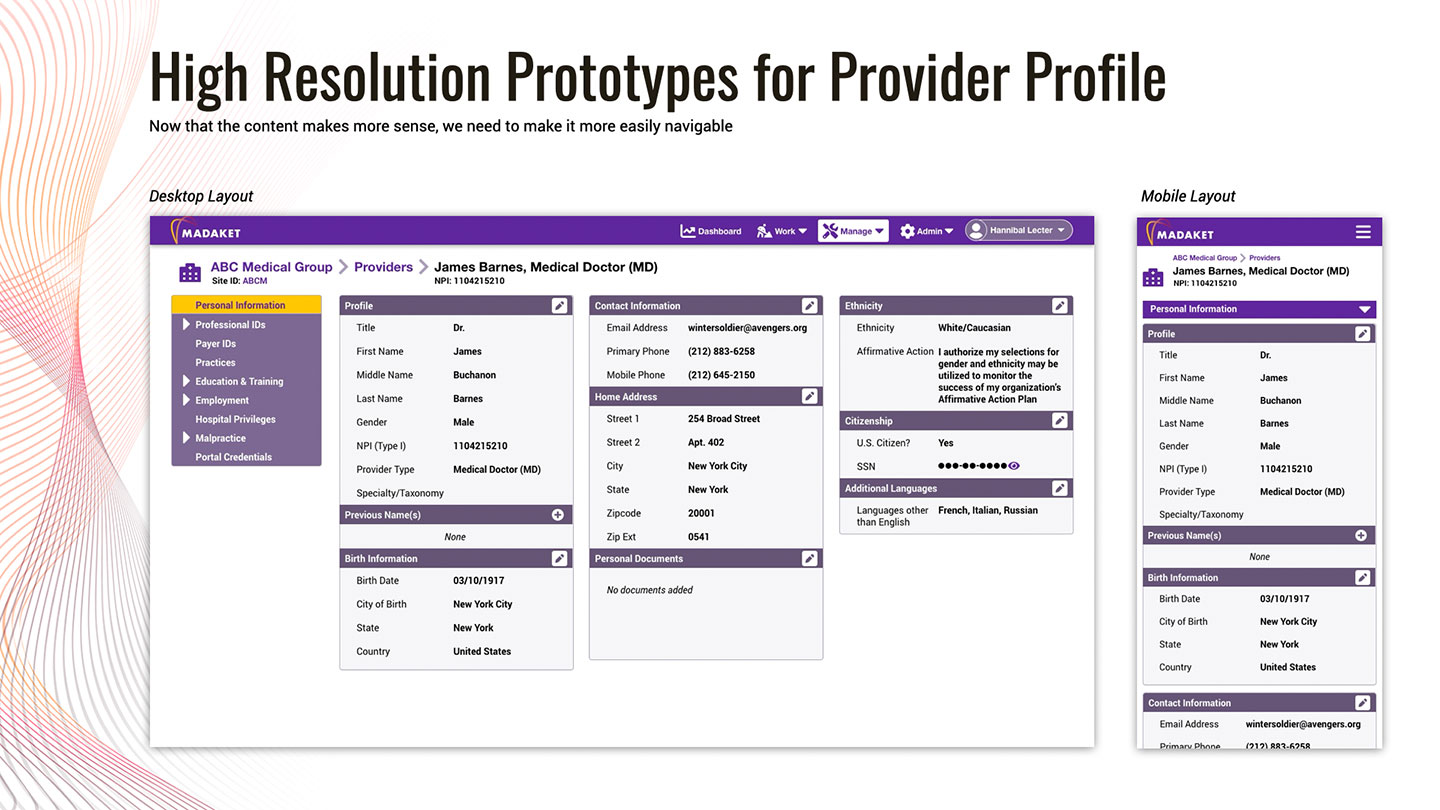
Now that the content is organized and makes more sense, we needed to make it easier to navigate with a completely redesigned provider profile editor.
Workflow Misalignment (Enrollment vs Participation)
When creating the EDI enrollment product, the Madaket engineering team built a very flexible and robust workflow engine, and it is quite good at preparing customized documents in a wide variety of ways through a configurable task management system. The engineering team did not want to lose that flexibility.
Through user research calls, social media posts, and online payer documentation, we determined that while an enrollment engine is ideal for EDI Enrollment, it lacks the ability to monitor ongoing updates that payers require for continual participation, such as:
- Bi-annual Re-credentialing
- Demographic changes such as adding practice location(s) or name changes
- Termination of a provider
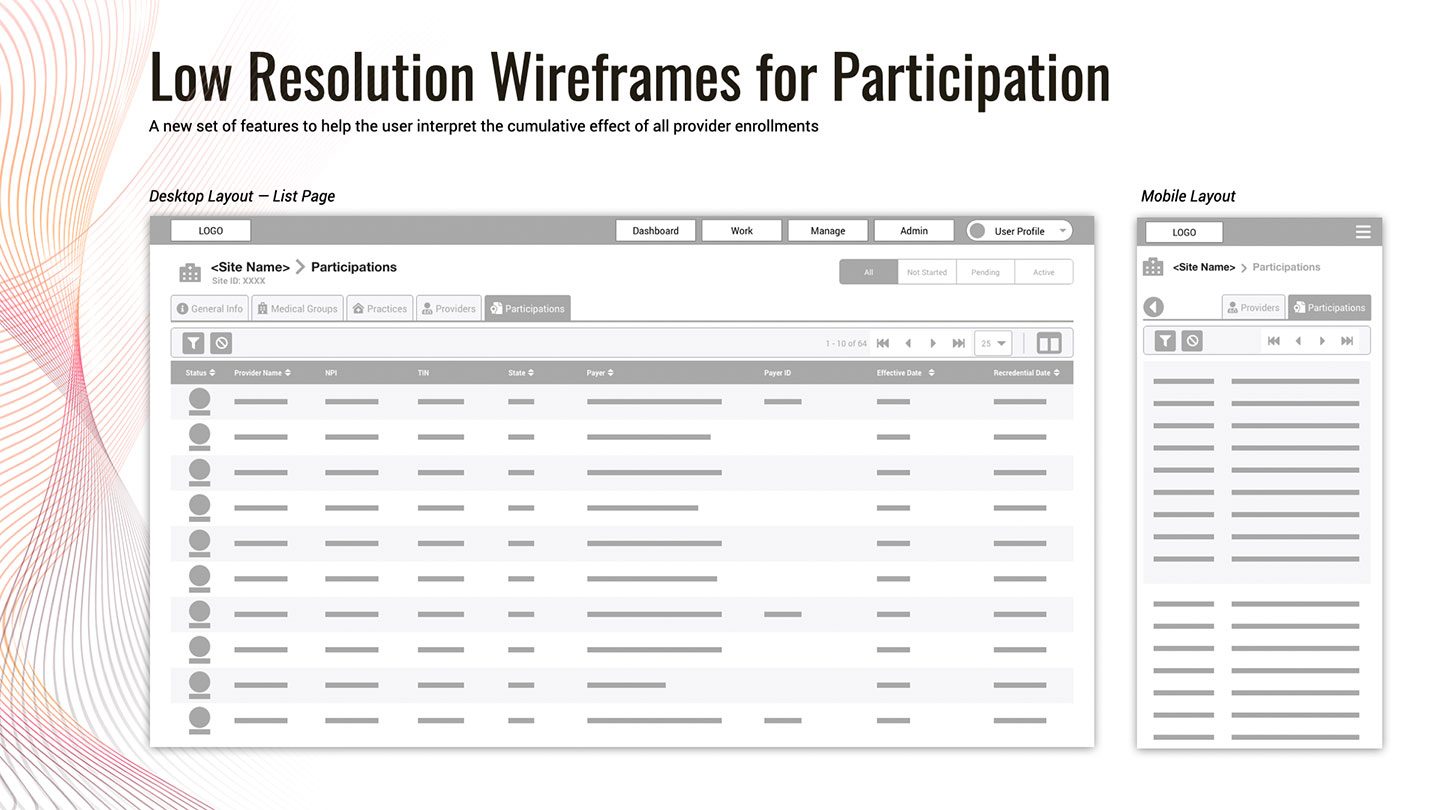
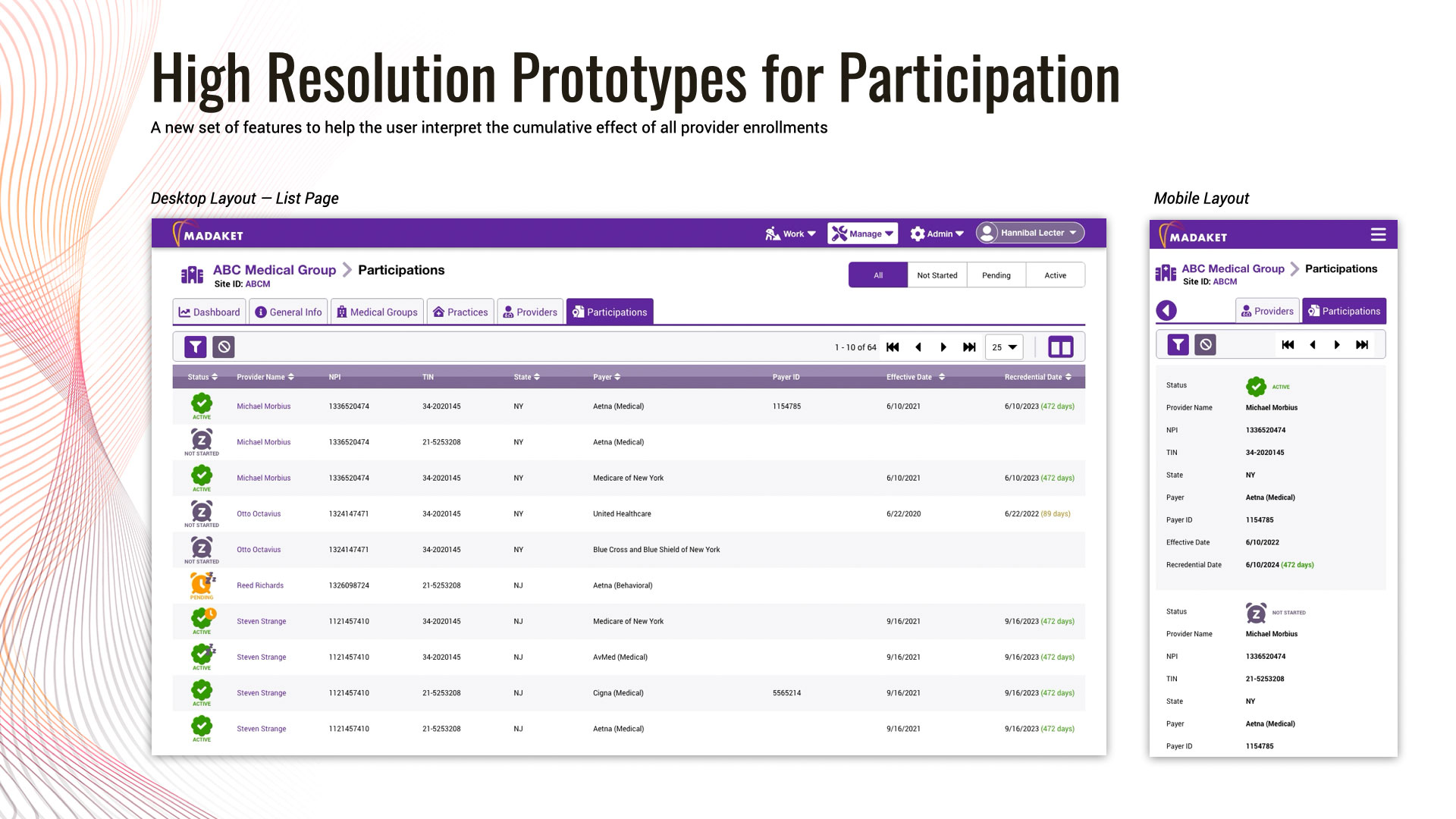
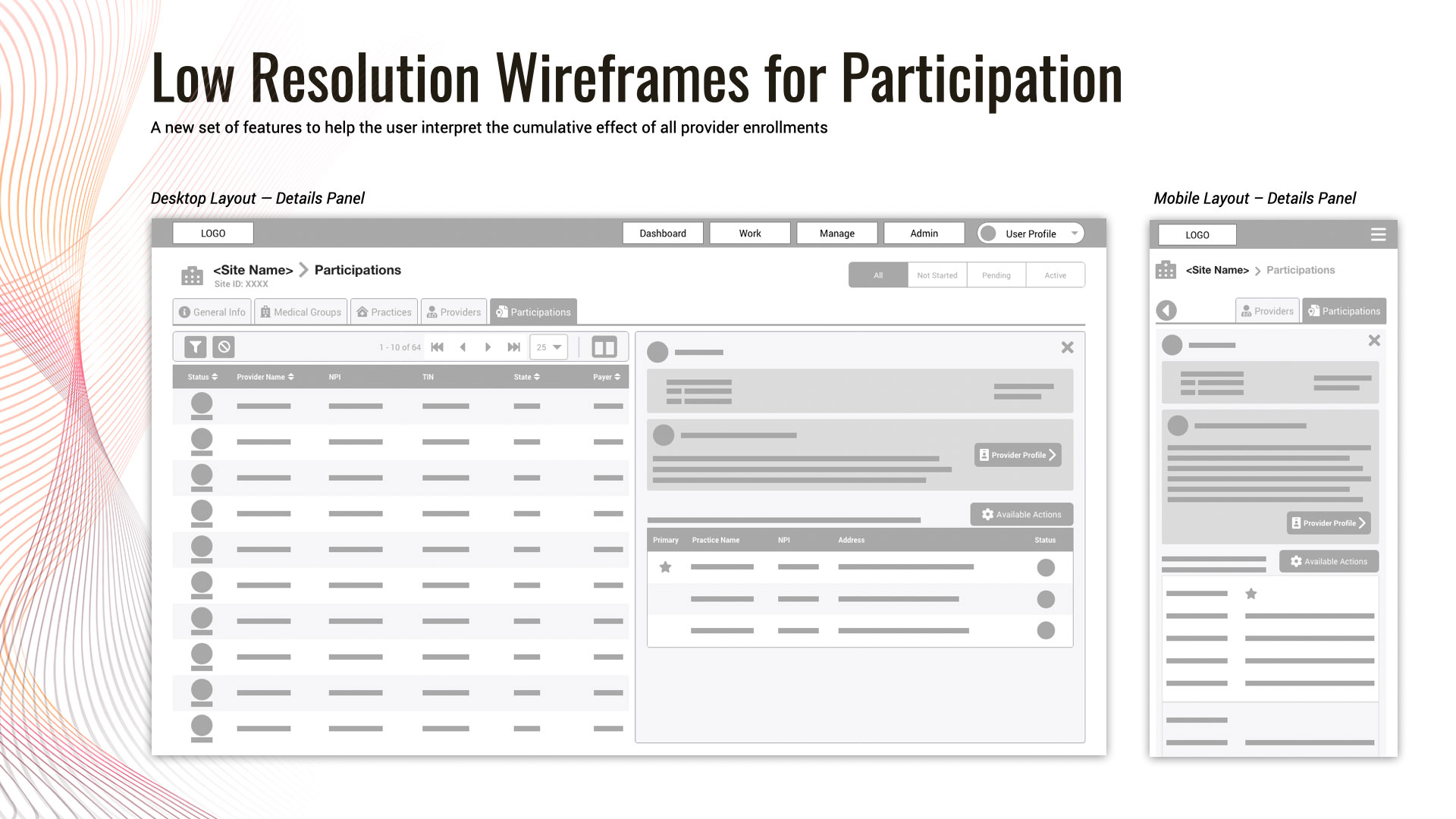
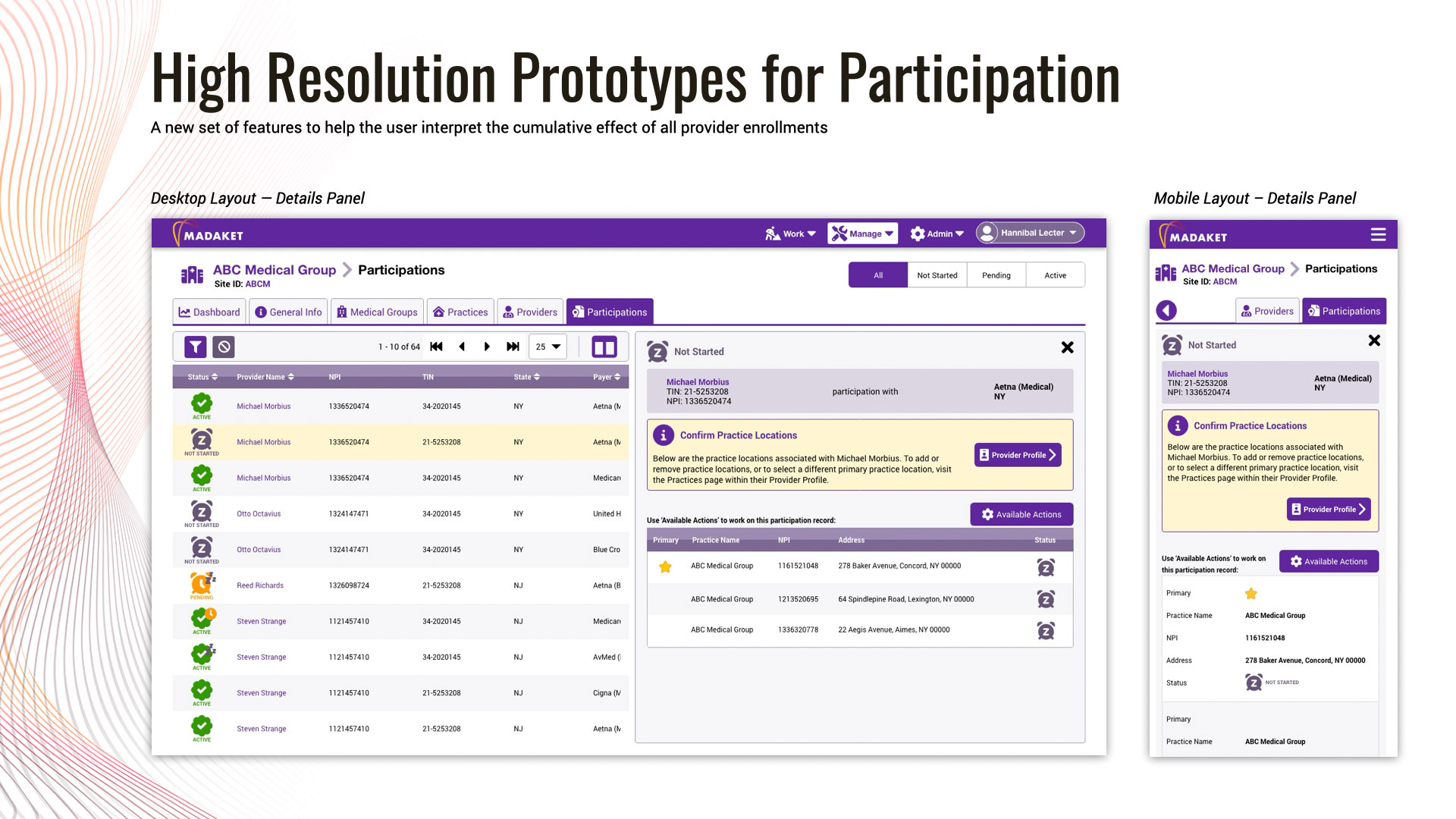
Discussions with customers revealed that we needed to offer a feature set to give provider organizations the ability to
view and take action upon all their overall provider's participations, rather than working enrollments.
Mapping out process flows was a revelation.
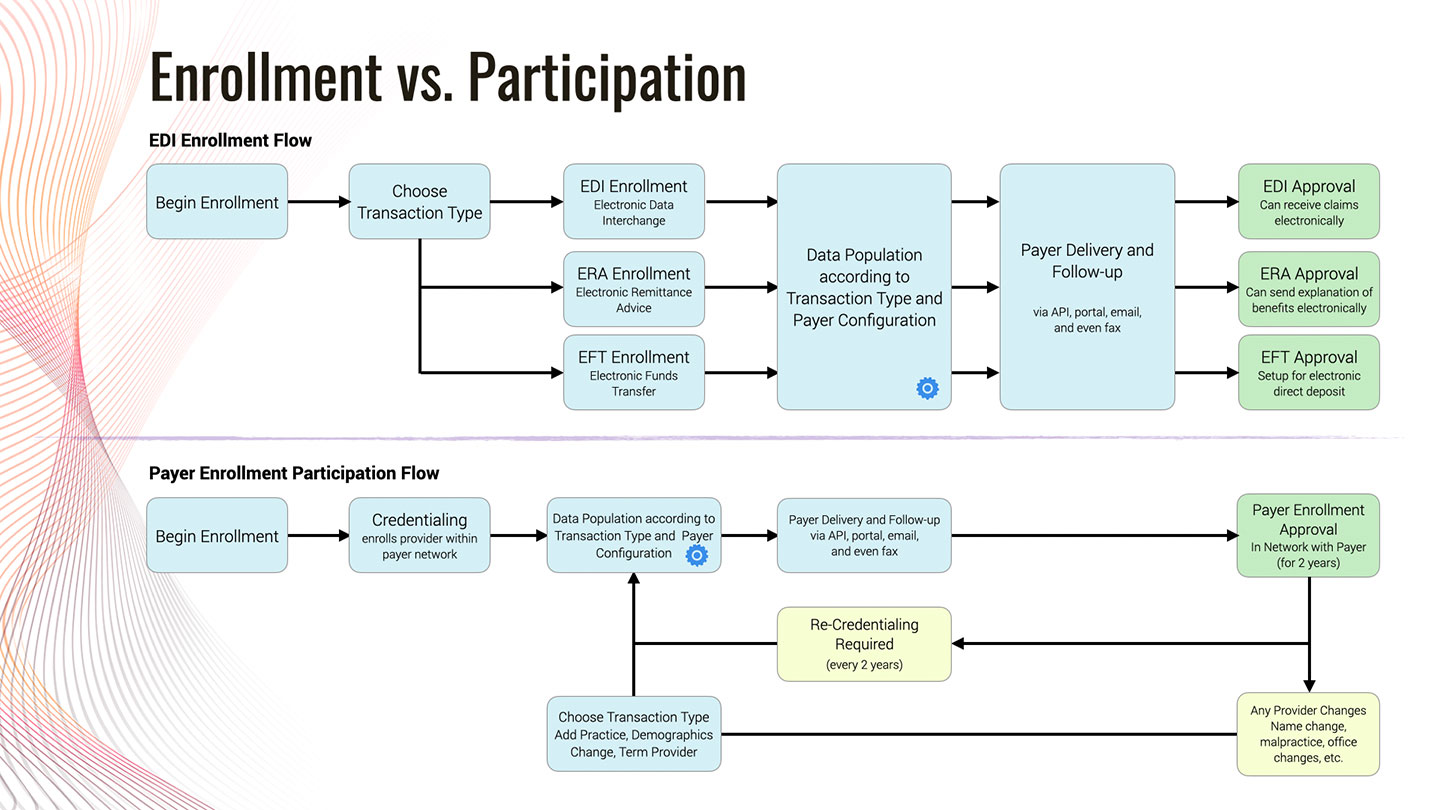
With a full understanding of the Participation process that providers have with their insurers, the product team was able to design a new set of features to make this process much easier to do through the Madaket Payer Enrollment system.
Result
After addressing issues with product personas, information architecture, and workflow, relaunching the Madaket Payer Enrollment application resulted in the following improvements:
- 250% Increase in paying clients within 6 months
- 200% Increase in number of active providers
- 300% Increase in number of processed enrollments
- 84% Percentage of enrollments managed within the new Participation system vs the previous enrollment list